
Watering on Sandy Soil
The single biggest factor in how your lawn looks — bigger than anything we apply.
We check irrigation before anything else on a free lawn inspection, because it explains more lawn problems than fertility and weeds combined.
Sandy coastal soil doesn't behave like the clay or loam most watering advice assumes. Water moves through it fast, and nutrients go with it. Getting watering right here isn't a refinement — it's the foundation.
The Rule: Deep and Infrequent
About one inch per week including rain, delivered in one or two soakings rather than a little every day.
On sand, splitting into two sessions of roughly half an inch often works better than a single inch, because sand simply can't hold that much at once — the excess drains past the roots.
Why daily watering hurts
Shallow, frequent water keeps moisture at the surface, so roots have no reason to grow down. You get a shallow root system entirely dependent on you. Then August arrives, you miss a few days, and the lawn browns fast. Deep watering trains roots downward where soil stays cooler and moister.
Water Early Morning
Between about 4am and 9am. Two reasons, both significant here:
- Less evaporation. Midday watering loses a meaningful portion before it reaches the roots.
- Blades dry during the day. This matters enormously in coastal humidity — grass left wet overnight is how brown patch and dollar spot establish.
Evening watering is the most common cause of preventable fungal disease we see in summer.
How to Measure What You're Actually Applying
Most people have no idea how much water their system puts down. Finding out takes fifteen minutes:
- Set several straight-sided containers around a zone — tuna cans work well
- Run the zone for 15 minutes
- Measure the depth collected in each
- Multiply by four to get the hourly rate
- Calculate the runtime needed for half an inch
The containers also reveal coverage problems — if one has twice as much as another, you have a head or spacing issue, and that's why part of your lawn looks worse.
The Screwdriver Test
The simplest check there is. After watering, push a long screwdriver into the soil. It should slide in easily to about six inches. If it stops at two, you're not watering deeply enough. If the ground is soggy hours later, you're overwatering.
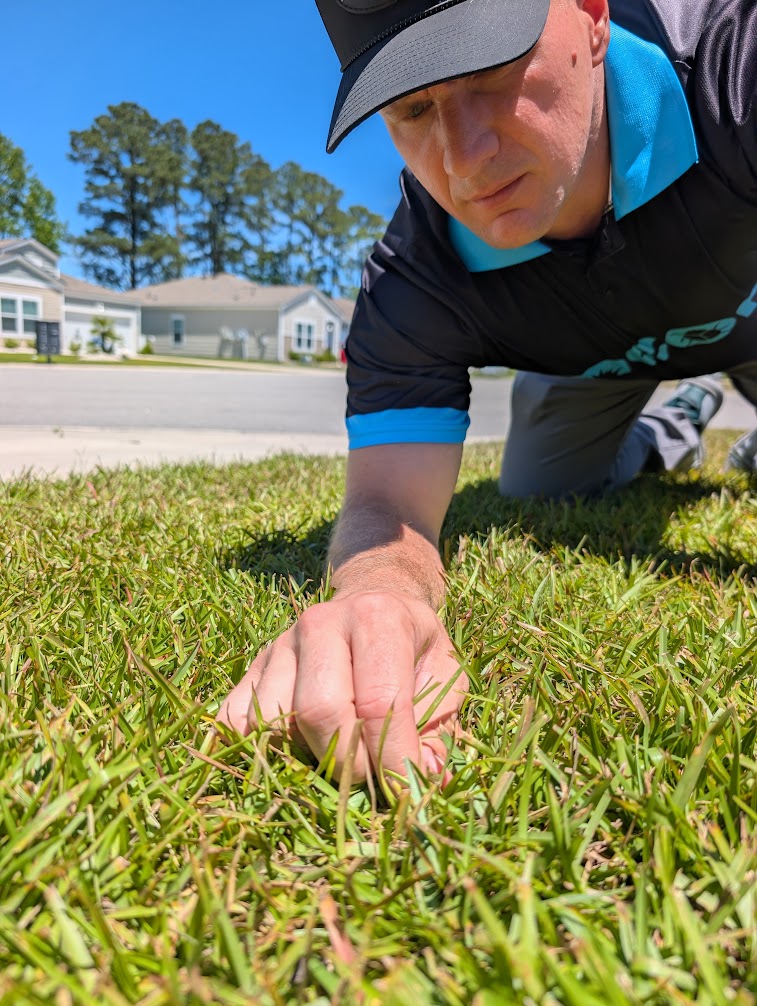

Signs You've Got It Wrong
Underwatering
- Footprints stay visible after you walk across the lawn
- Blades fold or curl lengthwise
- Color shifts blue-grey before it browns
- Soil is hard and dry a few inches down
Overwatering
- Spongy, soft ground
- Mushrooms appearing
- Increased fungal disease and thinning
- Moss in shaded areas
- Weeds that favor wet soil, like dollarweed
Adjust for rain, and for season
A rain sensor pays for itself — running a full cycle after a thunderstorm wastes water and encourages disease. And dormant winter turf needs almost nothing. Leaving a summer schedule running through December is common here and does real harm.
Common Questions
My system runs 10 minutes daily. Is that fine?
Almost certainly not. Ten minutes daily is the textbook shallow-watering pattern — it keeps roots at the surface. Same total water applied twice a week for longer would serve the lawn far better.
What about brand new sod?
New sod is the exception and does need frequent light watering while it roots — often daily at first. Then you taper toward deep and infrequent over the following weeks. We give written instructions with every sod installation.
Do I need to water in winter?
Rarely. Dormant warm-season grass uses very little. An occasional watering during an unusually long dry spell is enough.
We'll check your system and tell you exactly what to change.