
Mosquito Control in Longs, SC
Big wooded lots, roadside ditches and treelines that hold mosquitoes all day. This is our home base — the shop is right here on Hwy 9.
Or book a free evaluation and we'll find your breeding sources.
Longs is home for us — our shop is on Hwy 9 in Longs, so these are the lots our crews know best. And the thing about a big Longs lot is that the same features you bought it for, the woods and the space, are exactly what mosquitoes love.
Away from the saltmarsh, Longs is a different kind of mosquito country: larger lots, a lot of new construction, roadside and drainage ditches, retention and stormwater ponds, and treelines left standing along property lines. The trees matter more than most people realize. Adult mosquitoes don't spend the day in open sun — they retreat into cool, humid, shaded harborage, and a mature treeline or a strip of retained woods is a five-star hotel for them. Combine that resting habitat with ditches and low spots that hold water for days after a storm, and you get steady pressure through the whole warm season.
The treeline is the problem and the target
On an open lot with no shade, mosquitoes have nowhere to hide from the midday heat. On a wooded Longs lot, they have the whole treeline. That's why our fogging focuses hard on the shaded edges of your property — the woods line, the fence rows, the dense shrubs — where the day-resting adults actually are, rather than just the open lawn where you notice the bites.
Mosquito Season in Longs
- March–May — activity begins as temperatures climb; spring rain fills ditches and low spots.
- June–September — peak. Heat and afternoon thunderstorms keep ditches and ponds topped off.
- October–November — pressure tapers but hangs on in the shade along the treelines.
- Winter — mostly quiet, though warm spells can bring short resurgences.
Where They're Breeding on Your Property
Some breeding water on a big Longs lot you can drain; some you can't. Either way, your technician finds it:
- Roadside and drainage ditches that hold water for days after rain
- Low spots and ruts on graded new-construction lots
- Silt fencing, tarps and construction debris trapping water
- Clogged gutters — the single most overlooked source
- Pond and pool edges, birdbaths and plant saucers
- Old tires, buckets, wheelbarrows, tractor equipment and toys
Your technician walks the property and points these out. Fixing the ones you can is usually free and does more than any treatment.
The Season, in Real Terms
Our mosquito program runs 7 monthly treatments, starting in April or early May and continuing through October or early November — the stretch when mosquitoes are actually active on this coast. The cost is spread evenly over 12 monthly payments, so your bill stays level even though the visits are seasonal. Every visit is the same two-step process.
How We Actually Treat It — A Two-Step Process
Killing today's adults does nothing about tomorrow's. So we treat both ends of the mosquito's life cycle.
1. Fogging — the adults
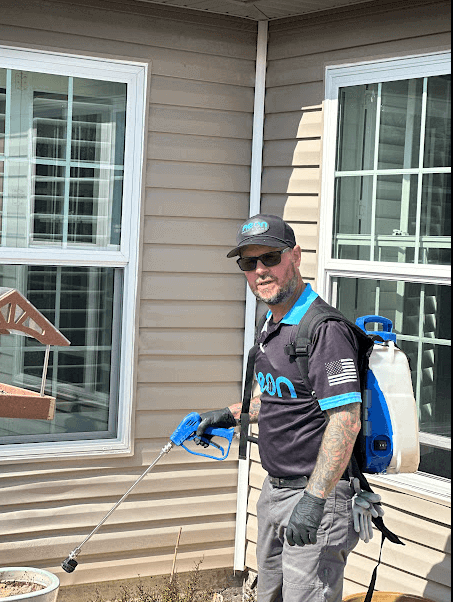
Using a backpack mister, your technician fogs the treeline, fence rows, dense shrubs and shaded harborage where mosquitoes rest during the day with OneGuard. On a wooded Longs lot that shaded edge is where the population actually lives, so that's where the fog goes. It knocks down the adults on your property and leaves residual on the foliage where they land.
Heavy rain shortens it. That's not a product failure — it's exactly why treatment is recurring through the season rather than one-and-done, especially on a lot with ditches that keep refilling.
2. Altosid granules — the larvae
Applied to the standing-water sources you can't eliminate — ditches, low spots, pond edges, downspouts — to stop breeding before it starts. The active ingredient is (S)-methoprene, an insect growth regulator.
It doesn't kill larvae outright. Larvae develop normally right up to the pupal stage — then die before emerging as biting adults. The mosquito never completes its life cycle.
- Provides up to about 30 days of control in standing water
- Target-specific — does not affect fish, waterfowl, mammals or beneficial predatory insects, which matters around ponds
- Used in the places you can't drain: ditches, low spots, downspouts, catch basins, pond margins
This is the part that compounds
Fogging alone means killing adults that keep getting replaced — and on a wet, wooded lot the replacements keep coming out of the ditches. Add the granules and fewer adults get produced in the first place. Run both through 7 monthly visits and the population you're fighting in August is smaller than it would have been. It won't be zero on a big wooded lot. It will be a yard you can actually enjoy.
Common Questions
Will one treatment fix it?
No. On a wooded lot with ditches, adults keep emerging and the treeline keeps sheltering them. Control means recurring treatment through the active season, paired with removing what standing water you can.
Can you treat the ditch along my road?
We treat the standing water on your property with larvicide, including drainage ditches and low spots within your lot. Public roadside ditches and the woods beyond your line aren't ours to treat, but knocking down what's on your property makes a real difference to what reaches your yard.
Do mosquito treatments hurt pollinators?
Application matters. Treatments are directed at shaded resting areas rather than blooming plants, and timing avoids peak pollinator activity where possible. Your technician applies according to the product label, which includes pollinator protection requirements.
Do you use mosquito traps?
No. Traps catch a small fraction of the population and do nothing about the treeline harborage or the ditches breeding mosquitoes on the rest of your lot. Our two-step program of fogging and larvicide treats the adults you have now and prevents the next generation, which does more than any trap.
Communities we serve in Longs: Colonial Charters, The Farm at Timberlake, Long Bay, Aberdeen, Sunset Acres, Bishops Landing, and the rural and new-construction lots along Hwy 9, Hwy 905 and Highway 57.
Nearby on the water? See mosquito control in Little River and North Myrtle Beach, or the full pest control in Longs plan.
Get Your Longs Evenings Back
We'll find the sources and treat the resting areas.
Click for Instant Pricing →